What we can learn from the Coroner’s E-Bike Death Review
Last week, the Office of the Chief Coroner released a review of e-bike deaths in Ontario. I had the chance to sit down and review the full report. I’ve got a lot of thoughts, summarized in this blog.
The report builds on the work of the Ottawa Fatal Collision Review Committee that examined five e-bike deaths involving e-bike riders in 2021. The report also includes a literature review, an analysis of 25 traffic fatalities involving e-bikes across the province that occurred between 2012-2021, as well as seven recommendations for defining e-bikes and assessing safety.
Before I jump into my thoughts on the report itself, I wanted to acknowledge that the numbers in this report are not just numbers, they represent lives lost on the road. I am saddened that each of these deaths occurred. The province needs to make vulnerable road user safety a priority and I hope that this report plays a role in supporting e-biking as a safe, fun, healthy, and sustainable mode of transportation and recreation.
Here are some of my main takeaways from this report:
The e-bikes involved resemble motorcycle and scooter style devices, not bicycle-style e-bikes.
The devices involved in Ottawa’s fatal collision review* all resemble motorcycle and scooter style vehicles, not bicycle-style e-bikes (pictured below). This is important context for how we understand and use this report. The report also acknowledges the challenges that come with such a broad definition of e-bikes.
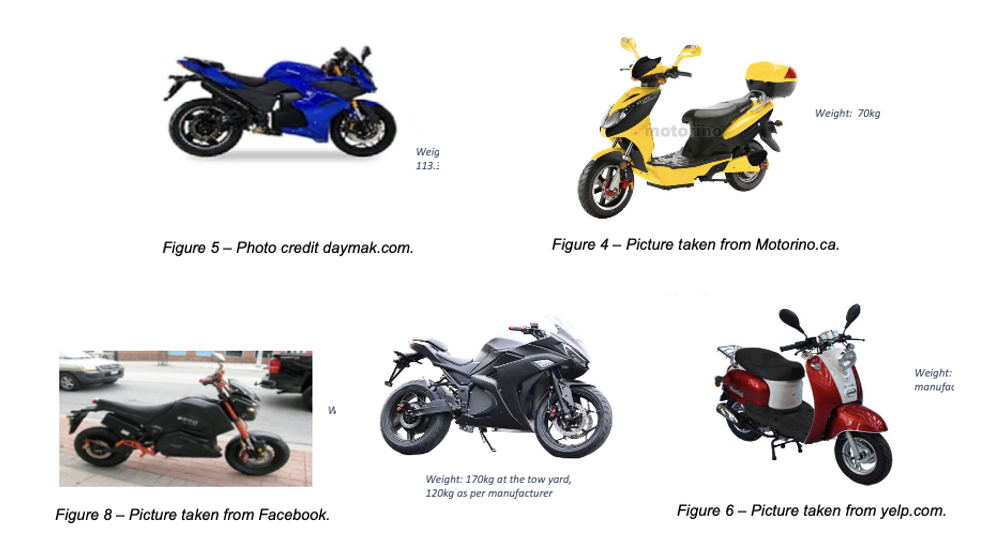
Image: Devices involved in e-bike fatalities in Ottawa
*Device type information was not available for the other 25 deaths reviewed across Ontario.
Speed modification is a significant factor in e-bike deaths.
All of the devices included in Ottawa’s fatal collision review had been modified in some way to increase their speed. In the three fatalities where speed was recorded, the device was travelling between 43km/h and 70km/h, well above the legal maximum of 32km/h for e-bikes. The report also notes that a sales website for one of the devices stated that they could be modified to go up to 90km/h.
Modification information was not available for the other 25 fatalities across Ontario.
The report notes that because e-bikes with a speed of less than 32km/h are considered “restricted-use vehicles”, any modifications made prior to initial retail sale are not regulated by federal law. After sale modifications fall under provincial or municipal jurisdiction.
I didn’t see this emphasized in the report, but the modification of e-bikes is already illegal as part of O. Reg. 369/09: Power-assisted bicycles.
Other factors include gender, age, and substance use.
When looking at the 25 fatalities across Ontario between 2012-2021, the vast majority were males (96%) over 45 years old (76%). When a toxicology report was performed, drugs were present in 69% of cases. Most fatalities occurred on public roads (88%) and the rider was wearing a helmet (60%).
When driver license status was known, 50% of those involved had an active drivers license, 29% had a suspended license, and 21% had a cancelled license or were never licensed. The report also notes that all fatalities involved the operator of the e-bike (aka. not a passenger, or nearby pedestrian).
Report Recommendations
The report outlines seven recommendations aimed at enhancing public safety on roads in Ontario. For the purposes of this blog I focus mostly on the first two recommendations, that MTO (1) provide a revised clear definition of an e-bike as a pedal assisted bicycle, and (2) consider a separate classification approach for all low-speed electric motorcycle type and “Vespa like” scooter vehicles.
For the revised definition, the report recommends that e-bikes be defined as pedal-assisted bicycles with the following requirements:
Two or three wheels,
Primary source of propulsion through human power (pedaling),
An electric motor with a continuous rated output power not exceeding 500 watts,
Pedals must be used by rider to set or keep the vehicle in motion,
Propulsion assistance cannot increase travel speed beyond 32km/h,
Presence of handlebars for steering and an adjustable seat,
Weight of no more than 55kg.
Within the definition there should be consideration given to specialized e-bikes such as cargo bikes, family bikes and recumbent bikes.
In terms of the classification approach, the report outlines the following:
Motorcycle and scooter type e-vehicles should not be classified as e-bikes or power-assisted bicycles.
Consideration should be given to regulating these types of vehicles and requiring licensing and insurance.
Scooter type e-vehicles and motorcycle type e-vehicles may require different regulations, licensing, and insurance due to their different structure and possible uses.
The full recommendations can be found on p. 22-23 of the report, including additional recommendations about data collection and working together to develop and implement measures to support effective enforcement of a safe speed limit.
I wholeheartedly agree with the report finding that current e-bike definitions are too broad and should be narrowed to better distinguish between different types of vehicles. This is something that advocates have been pushing for years, and that the province has acknowledged needs to change. It was identified as an action in the now defunct CycleOn Action Plan 2.0 in 2018, in 2021 the MTO sought to create e-bike categories as part of a since repealed section of the MOMS Act, and it was most recently codified as a need with the passing of Bill 197 in 2024, which gave the MTO regulatory powers to create e-bike categories. This report is one more acknowledgement of this need. I hope it opens the door for action to (finally) get this done.
That being said, I am wary of the influence these findings will have on regulating bicycle-style e-bikes. I agree with most of the proposed e-bike requirements outlined above (see my previous blog post on best practices for defining e-bikes). However my largest concern with the new proposed definition is that its focus is pedal-assist e-bikes only. What about throttle-assist e-bikes, which have a similar weight and design and maximum speed as pedal-assist e-bikes? These are extremely popular (full disclosure, I have one), and there is no evidence in this report to suggest they are more dangerous than pedal-assist e-bikes.
Closing thoughts
Overall, I can’t help but be disappointed in the narrative that this is a review of deaths involving e-bikes. The devices identified are not bicycle-style e-bikes, but that’s likely what most people will think of. When the device type is known, the devices involved have been modified motorcycle-style e-vehicles, and modification is illegal. The illegal modification of the devices is a critical finding that requires more prominence. As it stands, the report may feed into existing narratives about how all e-bikes are somehow reckless and dangerous.
I don’t want us to take the wrong lessons from this report and over-restrict bicycle-style e-bikes and the mobility of people who use them. Yes, the devices involved in the Ottawa fatalities had throttles, but they were modified to travel well over 32km/h (up to 70km/h in two cases). This does not amount to evidence for prohibiting bicycle-style throttle-assist bicycles with a maximum speed of 32km/h. Hopefully we can continue to make the case for throttle-assist e-bikes as part of provincial definitions and categories.
I anticipate that the release of the report may lead to the MTO releasing draft definitions and e-bike categories on the Environmental Registry for comment in the near future.
These were some of my reflections on the report, what were your key takeaways? What do you hope happens next? Send me an email and let me know.