My comments: Ontario’s proposed e-bike framework
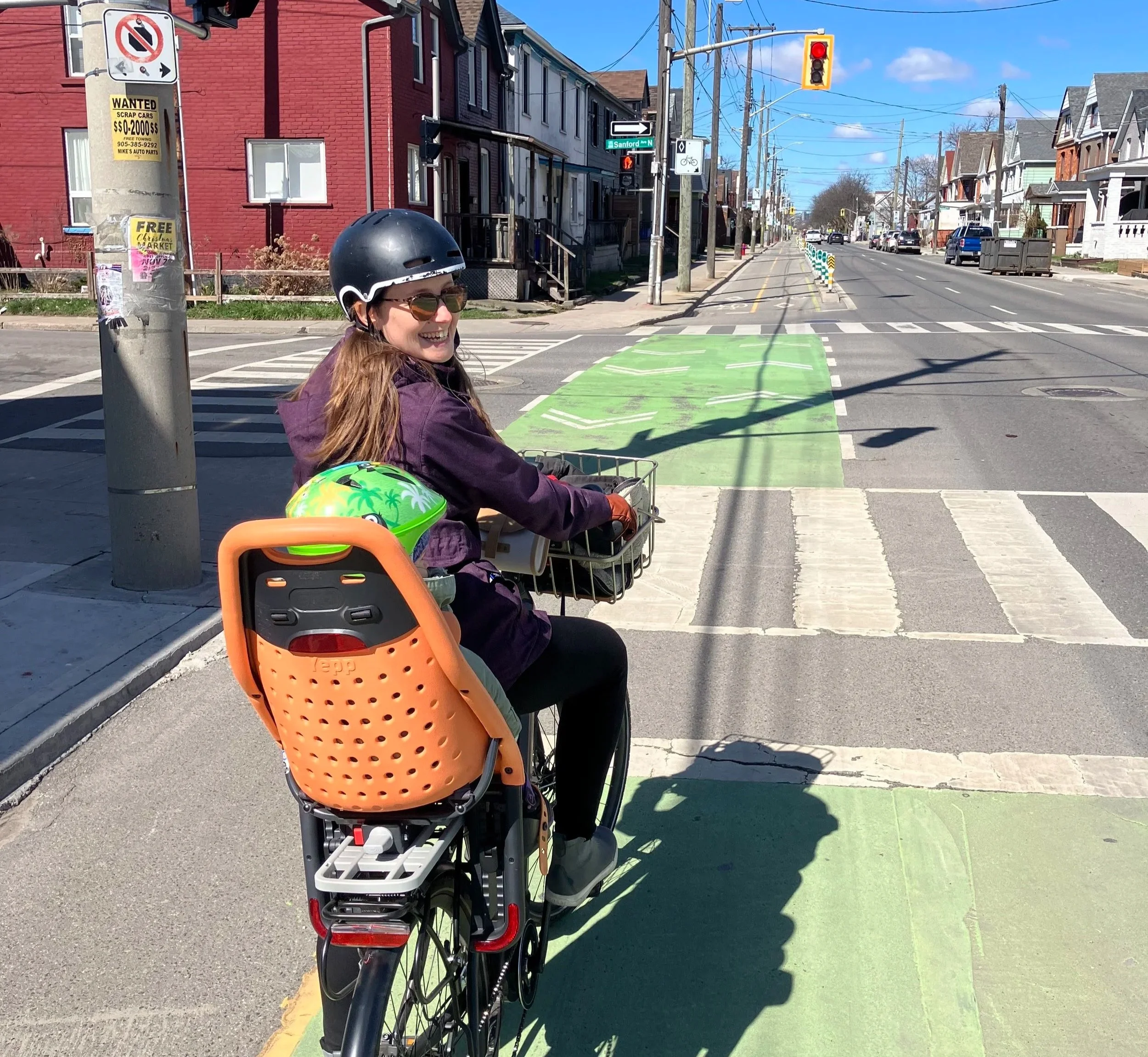
In April 2026, Ontario’s Ministry of Transportation released a new proposed framework for defining e-bikes. E-bike policy has become a real passion of mine, professionally and personally. I’ve been riding an e-bike since 2021 and it’s changed the way I get around. I’ve had the opportunity to work on several e-bike projects as a consultant, advising municipalities and nonprofits on e-bike policy and programs, and I’ve done numerous media interviews on why I love e-bikes. I have also delegated at Queen’s Park twice about my desire to legally ride my e-bike with my daughter on board as a passenger.
So when the proposed framework was released for comment, I had thoughts. Mostly good ones!
I’ve shared a draft of the comments I will be submitting to the Ministry below. My comments reflect my views and experiences, as well as what I heard when I hosted a webinar to discuss the proposal with partners from across the province.
Comments are due to the Ministry through the Regulatory Registry by June 8th. I encourage everyone to take this opportunity to share your thoughts.
My draft comments:
Dear Road Safety Team,
Thank you for the opportunity to review and comment on your proposal to modernize Ontario’s Framework for Power-Assisted Bicycles (E-Bikes) through the Regulatory Registry. As an active transportation consultant and e-bike rider who has been working to increase access to cycling for nearly 20 years, I support efforts to update the rules for e-biking and establish new classes that recognize the technological and safety innovations of the past few decades.
E-bikes have the potential to grow cycling and address many of the cycling barriers people experience, such as travelling longer distances, cycling up hills, keeping up with friends, cycling with physical limitations, and carrying cargo. For decades, uncertainty about e-bike definitions and rules have been holding us back on reaching this full potential.
I believe that this proposed framework is a step in the right direction for e-bikes in Ontario and that it would be a helpful tool for municipalities to promote and regulate e-bikes. I was pleased to see past comments from myself and other partners reflected in the proposed framework. In particular, I was pleased the see the following:
Repeal of the child passenger ban.
Defining bicycle-style e-bike separately from electric mopeds/motorcycles.
Identification of new ways of distinguishing between bicycle-style e-bikes and electric mopeds/motorcycles.
General alignment with other jurisdictions (US class 1 and class 2).
Continued access to throttle-assist e-bikes (class 2).
Maintenance of the 32km/h assisted speed limit for bicycle-style e-bikes.
Recognition of the walk-assist function.
Continued access to e-bikes without licensing, registration, or insurance.
As part of the proposal comment period, my firm hosted a webinar to discuss the proposal with our partners. The webinar was attended by 65 engaged participants, including e-bike riders (current and prospective), staff from public, private and non-profit sectors, volunteers, retailers, shared system operators, and academia. Webinar participants were also supportive of the proposed framework, with 80% agreeing that it would help them address the major issues they encounter related to e-bikes. The proposed framework was identified as most likely to improve safety and clarity around e-bikes.
I have shared a full summary of the webinar discussion via email for your reference, and made it publicly available through my website.
As we move forward, I would encourage the Ministry to also consider the following:
Identify clear mechanisms that ensure retailers are selling legal e-bikes.
Collaborate with partners to prioritize education over individual enforcement.
Push for lithium-ion battery certification standards for e-bikes.
Clarify whether “no modifications” will still refer to speed and power modifications.
Consider adjusting the weight requirements to allow for heavier pedal-assist e-bikes in class 1 (e.g., Cycling Without Age trishaw at 97kg).
Work with academic partners and municipalities to evaluate the implementation of the proposed framework.
Consider whether bike share bikes can be exempted from the all-ages helmet requirement.
Provide a trade-in program for moped-style e-bike riders to transition to a legal device if the Ministry moves forward with licensing and federal safety standard requirements. (Note that I am not advocating for license requirements for moped-style e-bikes, but would like to see them defined separately from bicycle-style e-bikes).
Change the name of “motor-assisted bicycles (mopeds)” in the Highway Traffic Act to further clarify the legal distinction between e-bikes and mopeds.
Confirm that changes do not inadvertently exclude some bicycle-style e-bikes.
Continue to consult with a diverse group of e-bike riders and partners.
Attached, I provide additional comments and examples to expand on each of these recommendations.
Thanks once again for the opportunity to participate in your consultations and to share feedback. Please reach out if you have any questions or would like additional information on any of the points I have shared. I am also happy to help connect you with e-bike retailers, riders, and advocates in my network for additional conversations to help ensure that proposed categories are as clear, accessible, consistent, and inclusive as possible.
Sincerely,
Jamie Stuckless, Owner & Principal Consultant
Stuckless Consulting Inc.